

When Vision Changes are More than a Prescription Problem
Vision changes are often attributed to the need for stronger glasses or an updated contact lens prescription. In many cases, that may be true. However, when vision becomes distorted, unstable or increasingly difficult to correct, the shape of the cornea should be assessed more closely.
Keratoconus symptoms can develop gradually, and they are not always obvious at first. The early signs may feel like ordinary blurred vision, changing astigmatism or increasing difficulty with night vision, but the underlying issue can be a progressive change in the cornea itself.
What is Keratoconus?
Keratoconus is a progressive corneal condition where the normally rounded cornea becomes thinner and bulges into a more cone-like shape. The cornea is responsible for helping focus light as it enters the eye, so even subtle changes in its shape can affect the quality and stability of vision.
As the cornea becomes more irregular, light no longer focuses evenly on the retina. This can lead to blurred, distorted or fluctuating vision, and in some cases, standard glasses may become less effective at providing clear, consistent correction.
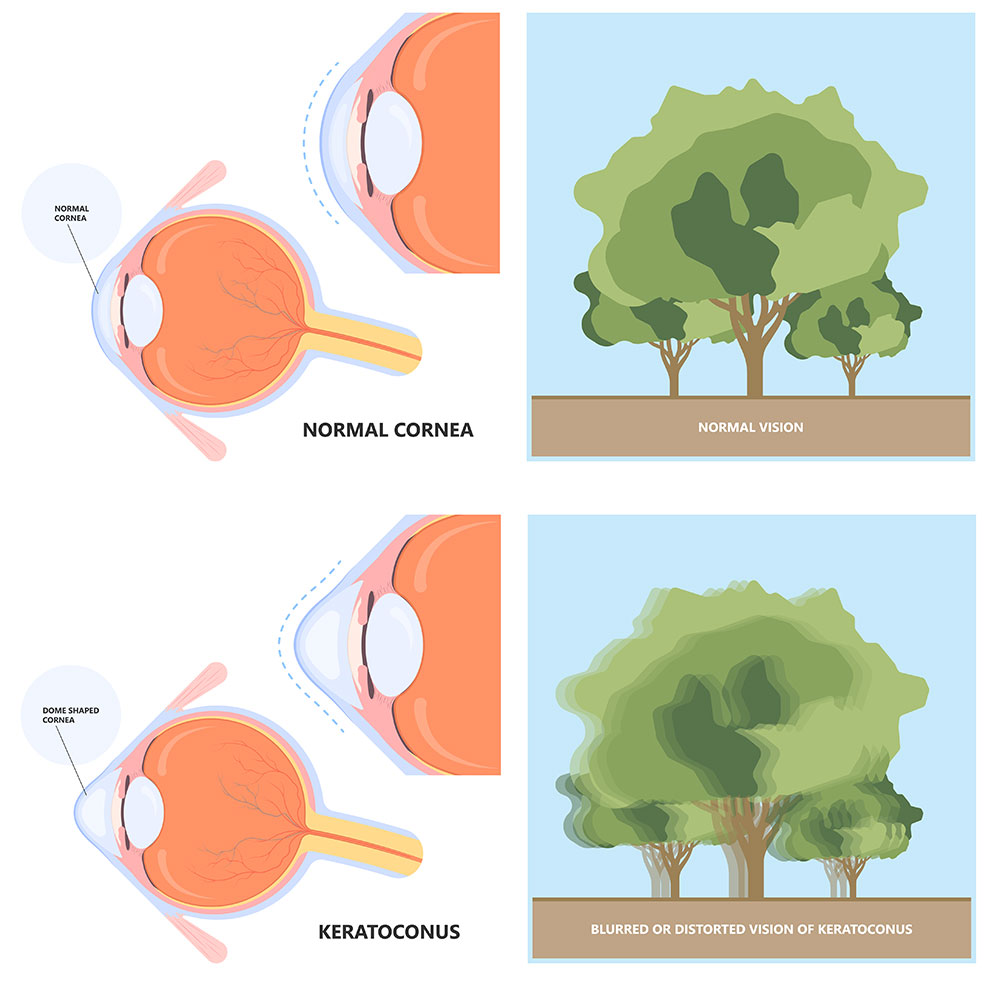
Keratoconus can cause blurred, distorted or unstable vision as the shape of the cornea changes.
Common Keratoconus Symptoms
Keratoconus symptoms are often related to irregular focus, rather than a simple reduction in visual sharpness. This is why some people find that glasses or soft contact lenses no longer provide the same level of clarity, even after a prescription update.
Common symptoms may include:
- Blurred or distorted vision: Vision may appear smeared, stretched, doubled or irregular. Some people describe this as looking through uneven glass, where objects are visible but not sharply defined.
- Frequent prescription changes: Glasses or contact lens prescriptions may change more often as the cornea becomes less regular. If each new prescription only helps briefly, the corneal shape may need closer assessment.
- Glare and halos around lights: Bright lights may appear scattered, especially at night. This can make night driving, headlights and low-light environments more visually difficult.
- Increasing astigmatism: Astigmatism may become harder to correct with standard glasses. In keratoconus, the astigmatism is often more irregular because the cornea itself is changing shape.
- Uneven vision between the eyes: One eye may be more affected than the other. This can make the symptoms less obvious at first, as the stronger eye may compensate during everyday tasks.
- Eye strain or headaches: The eyes may work harder to compensate for distorted focus. This can become more noticeable during reading, screen use or detailed visual work.
- Difficulty reading or seeing at a distance: Vision may feel less stable across different tasks. Words, road signs or fine details may appear less clear, even when the prescription seems reasonably up to date.
Why Keratoconus Symptoms Can Be Missed
Early keratoconus can resemble ordinary short-sightedness, astigmatism or a changing prescription. A person may update their glasses and still find that vision is not sharp, comfortable or consistent, particularly in low light or visually demanding situations.
Symptoms may also develop unevenly between the eyes. One eye may feel more blurred or distorted than the other, or vision may seem to fluctuate depending on lighting, tiredness and the task being performed. These patterns are one reason corneal assessment can be more useful than relying on symptoms alone.
Is it Keratoconus or Astigmatism?
Astigmatism is common and does not mean someone has keratoconus. Many people have regular astigmatism that can be corrected well with glasses, contact lenses or, in suitable cases, laser vision correction.
The concern is when astigmatism becomes increasingly irregular, changes more quickly than expected or is associated with symptoms such as ghosting, halos, distortion or poor correction with standard glasses. In keratoconus, the cornea itself is changing shape, which can create a more complex form of astigmatism that requires more detailed assessment.

Keratoconus may affect one eye more than the other, making symptoms feel uneven or difficult to recognise.
Why Keratoconus Symptoms May Become More Noticeable
Keratoconus symptoms are not always constant. Some people notice that their vision seems worse in particular situations, especially when the eye is working harder to manage glare, contrast or fine detail. These changes do not always mean the condition has suddenly progressed, but they can make the underlying irregularity in the cornea more obvious.
Symptoms may become more noticeable when:
- Driving at night or looking at bright lights creates more glare, halos or visual distortion.
- Reading, screen use or detailed close work makes blurred or unstable focus harder to ignore.
- Tiredness makes the eyes less able to compensate for irregular vision.
- Itchy or allergic eyes lead to repeated eye rubbing, which may place extra stress on the cornea.
- Glasses or standard contact lenses no longer provide the same level of clear, stable vision.
How Keratoconus is Diagnosed
Keratoconus diagnosis involves assessing the shape, curvature and thickness of the cornea. Corneal mapping, sometimes called corneal topography or tomography, can help identify irregular changes that may not be obvious from a standard prescription check alone.
At Ashford Advanced Eye Care, assessment is used to determine whether symptoms are due to keratoconus, another corneal condition or a different cause of blurred or distorted vision. This distinction matters because the most appropriate next step depends on the structure and stability of the cornea.
How Keratoconus Treatment is Planned
Keratoconus treatment depends on how advanced the condition is, whether the cornea is still changing, the thickness of the cornea and how much the vision is being affected. The first step is to understand whether the main concern is visual correction, progression of the condition or both.
Some people may be managed with monitoring, glasses or specialised contact lenses, depending on the stage of the condition. When keratoconus is progressing, corneal cross-linking may be considered to help stabilise the cornea and reduce the risk of further deterioration.
When Distorted Vision Needs a Closer Look
Distorted vision should be assessed when it is persistent, worsening or not properly corrected by glasses or contact lenses. This is particularly important if prescriptions keep changing, glare or halos are becoming more noticeable, night driving is more difficult, or one eye seems consistently different from the other.
At Ashford Advanced Eye Care, we can assess the cornea in detail, explain whether keratoconus may be involved and discuss whether monitoring or treatment may be appropriate. The aim is to identify the cause of the visual change and provide clear guidance on the most appropriate next step.
Understanding Changes in the Cornea
Keratoconus symptoms can begin subtly and may look like ordinary prescription change, astigmatism or general blurred vision. The important distinction is that keratoconus involves a change in the shape and structural stability of the cornea, which can make vision increasingly distorted, unstable or difficult to correct clearly.
If your vision keeps changing, feels distorted rather than simply blurred, or is no longer corrected well with glasses or contact lenses, a detailed corneal assessment can help identify what is happening. Please contact us for more information or book an assessment with Ashford Advanced Eye Care.
FAQs
Can keratoconus symptoms come and go?
Keratoconus symptoms may seem more noticeable in some situations than others, especially with night driving, screen use, tiredness or bright lights. The underlying corneal shape does not usually change from hour to hour, but visual strain and lighting can make distortion, glare or unstable focus more apparent.
Why do my glasses stop working properly with keratoconus?
Glasses can correct many ordinary prescription problems, but keratoconus can create an irregular corneal shape that is harder to correct with standard lenses. This is why vision may still feel blurred, distorted or unstable after a prescription update, especially if the cornea is continuing to change.
Can keratoconus affect one eye more than the other?
Yes, keratoconus can affect one eye more than the other. Some people notice that one eye feels blurrier, more distorted or harder to correct. This uneven pattern can make symptoms harder to recognise at first, particularly if the stronger eye is compensating during everyday tasks.
Is distorted vision always a sign of keratoconus?
No. Distorted vision can have several causes, including prescription change, dry eye, cataract, retinal conditions or other corneal problems. Keratoconus is one possible explanation, particularly when distortion is linked with changing astigmatism, glare, ghosting or reduced clarity despite updated glasses.
Can keratoconus be detected before symptoms are severe?
Yes, keratoconus can often be detected before symptoms become severe through detailed corneal assessment. Corneal mapping can show changes in curvature and shape that may not be obvious from vision symptoms alone. Earlier detection can help guide monitoring and treatment planning where needed.