
cTEN™ TransPRK Eye Surgery in Adelaide
No-Touch Laser Vision Correction Without a Corneal Flap
- 40+ years experience with over 30,000 eye surgeries
- Customised cTEN treatment planned using detailed corneal mapping and pupil analysis.
- 100+ peer-reviewed research papers, with expertise in astigmatism and laser vision correction.
- Personal care from A/Prof Michael Goggin, from suitability assessment through treatment and follow-up.
Medically reviewed by A/Prof Michael Goggin | Ophthalmologist, FRANZCO | Last updated on October 2026
TransPRK eye surgery uses a laser to reshape the cornea and improve how light focuses inside the eye. It can reduce dependence on glasses or contact lenses for short-sightedness, long-sightedness and astigmatism, without creating a corneal flap.
At Ashford Advanced Eye Care in Adelaide, we offer Customised Trans-Epithelial No-Touch PRK, known as cTEN. We assess your prescription, corneal shape and eye health to determine whether treatment is suitable, then explain the likely results and recovery so you can make an informed decision.
What Is TransPRK?
TransPRK stands for trans-epithelial photorefractive keratectomy. It is a surface laser treatment used to correct refractive errors such as short-sightedness, long-sightedness and astigmatism, when the prescription and corneal measurements are suitable for treatment.
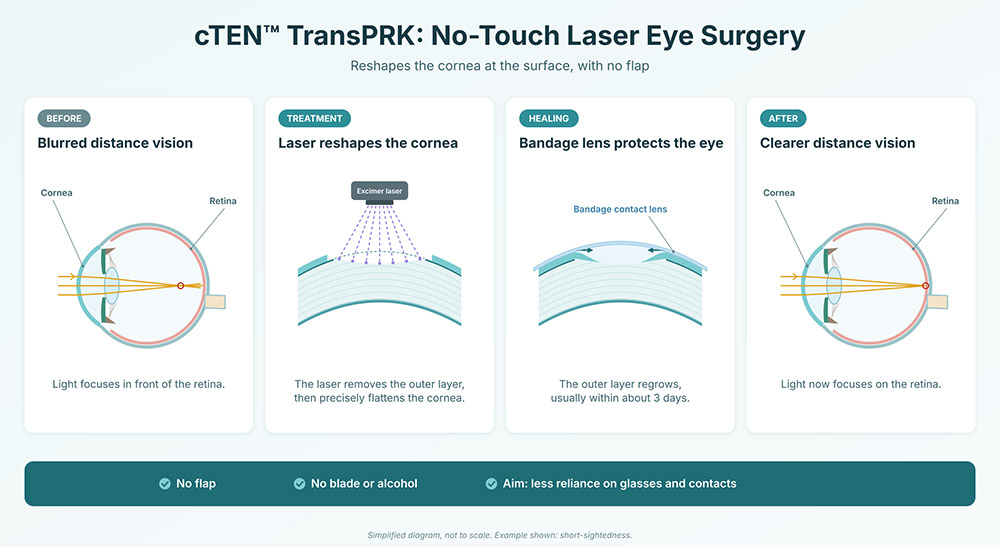
With TransPRK, an excimer laser removes the epithelium, the cornea’s outermost layer, before reshaping the underlying corneal tissue. The epithelium then grows back over the treated area. No corneal flap is made, and the cTEN treatment plan is customised using measurements of your eyes.
How TransPRK Works
The cornea bends light as it enters the eye. If light does not focus accurately on the retina, vision may be blurred without glasses or contact lenses. TransPRK changes the corneal curvature by removing microscopic amounts of tissue according to a planned laser profile.
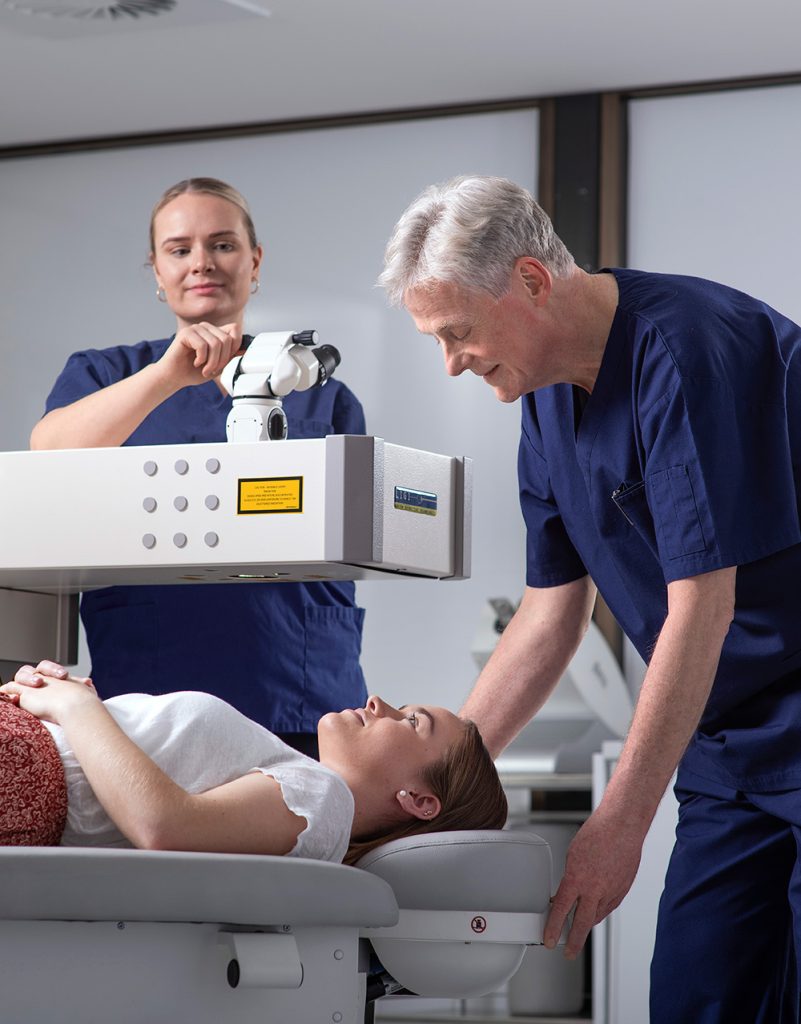
Anaesthetic drops numb the eye before treatment, and a small support keeps the eyelids open. The laser removes the surface epithelium and performs the correction, with active laser treatment typically lasting around a minute per eye. A temporary bandage contact lens is usually placed over the surface to protect it while the epithelium heals.
How Is TransPRK Different From Traditional PRK?
Both procedures reshape the cornea at the surface and avoid a LASIK flap. In traditional PRK, the surgeon removes the epithelium using an instrument or an alcohol-assisted technique. In TransPRK, the laser performs this step as well as the underlying correction.
No-touch refers specifically to the way the laser removes the surface layer of the cornea. TransPRK still involves a healing period, postoperative drops and follow-up appointments. Compared with LASIK, both forms of PRK have lower risk with recovery of vision about 4 days later. There may be more discomfort on the first day after the treatment. Painkillers are provided to cover that period.
Who Is Suitable for TransPRK?
TransPRK may be considered for adults with a stable prescription who want to reduce their reliance on corrective lenses. It may suit people who play contact sports or work in roles where an eye injury is more likely, as well as some people whose corneas are unsuitable for LASIK. A thinner cornea does not automatically make PRK safe, as enough healthy tissue must remain after treatment.
Your assessment considers:
- Prescription stability, usually over at least two years.
- Corneal thickness, shape and the amount of correction required.
- Dry eye, tear film quality and the health of the ocular surface.
- Conditions such as keratoconus, cataract or glaucoma.
- Medicines, medical history and factors that may affect healing.
- Pregnancy or breastfeeding, which can affect prescription stability and treatment timing.
Benefits of TransPRK
TransPRK offers a surface-based approach to vision correction for people who are suitable for treatment. It can improve unaided vision while leaving the cornea free of a surgical flap.
Potential benefits include:
- Reduced dependence on glasses and contact lenses: Treatment can make activities such as exercise, travel and daily work easier to manage without corrective eyewear.
- Correction of common refractive errors: TransPRK can treat suitable prescriptions for short-sightedness, long-sightedness and astigmatism.
- No corneal flap: Surface treatment avoids flap-related complications and may suit some contact sports or occupations.
- Laser removal of the surface layer: The no-touch technique uses the excimer laser rather than manual instruments to remove the epithelium.
- Treatment customised to your eyes: Detailed measurements guide the correction rather than relying on the glasses prescription alone.
TransPRK Recovery and Results
The corneal surface usually heals within 3 days and vision recovers to a useful level by day 4. Soreness, watering and light sensitivity are common initially, with clarity improving over the following weeks and sometimes continuing to stabilise for several months.
During your recovery, you can expect:
- A temporary bandage contact lens to protect the surface, removed by your clinician once healing allows.
- Around a week away from work, depending on your vision, occupation and progress.
- Prescribed eye drops and follow-up appointments to monitor healing.
- Advice on resuming exercise, swimming and other activities, with driving restarted once your vision meets the required standard and your surgeon confirms it is appropriate.
How Much Does TransPRK Cost in Adelaide?
TransPRK at Ashford Advanced Eye Care costs $2,800 per eye, including preoperative testing and postoperative follow-up appointments. Your initial laser vision correction consultation is free to the patient, and we explain the treatment plan, fees and inclusions before you book.
Your TransPRK Treatment Journey
Preparation and aftercare are important parts of surface laser treatment. We explain each stage in advance so you know what to arrange and how to look after your eyes at home.
Your Initial TransPRK Consultation
We examine your eyes, measure your prescription and map the cornea to assess whether TransPRK is suitable. We also discuss your expectations, whether you may still need glasses for some tasks and any alternative treatments worth considering.
Preparing for TransPRK Treatment
Contact lenses can temporarily change corneal measurements, so we advise how long to leave them out before testing or treatment. You will receive instructions about preparation, transport home and the early recovery period, when help with driving and some daily tasks may be useful.
Your TransPRK Procedure
The eyes are numbed with anaesthetic drops before the planned laser correction is performed. Afterwards, we explain how to use your medicines, protect the treated surface and contact the clinic if you have concerns.
TransPRK Follow-Up and Aftercare
Early reviews check that the surface is healing and establish when the bandage lens can be removed. Later appointments monitor vision and recovery, while increasing pain, worsening redness or a sudden reduction in sight should be reported urgently rather than left until a routine review.

Your Initial TransPRK Consultation
We examine your eyes, measure your prescription and map the cornea to assess whether TransPRK is suitable. We also discuss your expectations, whether you may still need glasses for some tasks and any alternative treatments worth considering.

Preparing for TransPRK Treatment
Contact lenses can temporarily change corneal measurements, so we advise how long to leave them out before testing or treatment. You will receive instructions about preparation, transport home and the early recovery period, when help with driving and some daily tasks may be useful.

Your TransPRK Procedure
The eyes are numbed with anaesthetic drops before the planned laser correction is performed. Afterwards, we explain how to use your medicines, protect the treated surface and contact the clinic if you have concerns.

TransPRK Follow-Up and Aftercare
Early reviews check that the surface is healing and establish when the bandage lens can be removed. Later appointments monitor vision and recovery, while increasing pain, worsening redness or a sudden reduction in sight should be reported urgently rather than left until a routine review.
Why Choose Ashford Advanced Eye Care for TransPRK?
Successful planning for surface laser treatment depends on understanding the cornea, including its shape, thickness and ability to heal. At Ashford Advanced Eye Care, we combine detailed measurements with experience in refractive surgery and corneal disease to assess whether cTEN TransPRK is appropriate for your eyes.
Our TransPRK care includes:
- Experience in laser vision correction: A/Prof Michael Goggin has performed and researched laser correction since 1993 and provided excimer laser treatment in Adelaide since 1998.
- Customised cTEN planning: Corneal mapping and pupil analysis help tailor the laser treatment to your individual eye.
- iVis laser technology: The iRES excimer laser removes the surface epithelium and reshapes the underlying cornea without creating a flap.
- Surgeon involvement during recovery: Follow-up care monitors surface healing, vision and the response to postoperative medication.
- Advice on alternative treatments: We explain when another procedure, or continued use of glasses or contact lenses, would be more appropriate.

Meet Associate Professor Michael Goggin

Extensive Experience in Laser Vision Correction and Corneal Care
Associate Professor Michael Goggin has performed and researched laser vision correction since 1993, with a particular interest in astigmatism and corneal disease. His approach to TransPRK combines detailed assessment, customised treatment planning and personal involvement throughout recovery.
His clinical experience is supported by research and teaching:
-
More Than 30,000 Eye Surgeries
Decades of surgical experience across cataract, refractive and other ophthalmic procedures. -
Over 100 Peer-Reviewed Research Papers
Published work informing the assessment, planning and outcomes of eye surgery. -
Internationally Recognised Astigmatism Expertise
Research and surgical teaching focused on understanding and correcting the eye’s focusing irregularities. -
Co-Editor-in-Chief of Clinical and Experimental Ophthalmology
Contributing to the evaluation and publication of ophthalmic research.
Book a TransPRK Assessment
Book a free initial laser vision correction consultation at Ashford Advanced Eye Care to find out whether cTEN TransPRK is suitable for your eyes. We’ll assess your vision, discuss your treatment options and explain what to expect before you decide whether to proceed.
To arrange your assessment:
- Call the clinic directly on Tel: (08) 8293 2700
- Book online via the Book an Assessment page
- Submit a general enquiry through the Contact Us page
- Complete your details on the Referral Page to generate a referral form
FAQs About TransPRK
Can I have TransPRK if I have been told I cannot have LASIK?
Sometimes, depending on why LASIK was ruled out. Surface treatment may suit certain eyes or lifestyles, but an unstable prescription, abnormal corneal shape or inadequate tissue thickness may make both procedures unsuitable.
Can TransPRK correct astigmatism?
TransPRK can treat suitable forms of refractive astigmatism within the available treatment range. Corneal mapping is important because irregular astigmatism associated with corneal disease needs a different assessment and may require another approach.
Can I have TransPRK if I have dry eyes?
Dry eye needs to be assessed before TransPRK because the tear film helps protect the corneal surface as it heals. We may recommend treating dryness first and repeating measurements once the surface is more stable. Having a flap-free procedure does not remove the need for a healthy ocular surface.
Is TransPRK painful?
Anaesthetic drops keep the eye numb during treatment. Soreness and light sensitivity can develop afterwards as the surface heals, and we provide medication and instructions to help manage this period.
What are the risks of TransPRK?
Possible risks include infection, corneal haze, persistent dryness, glare or halos, and under-correction or over-correction. Rarely, corneal weakening or lasting loss of visual quality can occur. We discuss your individual risks before treatment, and worsening pain, redness or reduced vision afterwards should be reported urgently.
When can I use screens after TransPRK?
You can usually return to short periods of screen use as comfort allows, although blurred vision and light sensitivity may make it difficult initially. Take breaks and use prescribed lubricating drops as directed, particularly if your work involves prolonged screen time.
How long do TransPRK results last?
TransPRK permanently reshapes the treated corneal tissue, and the correction can remain useful for many years. Your eyes can still change with age, however, and a later prescription change does not necessarily mean the original treatment has worn off.
Will I still need reading glasses after TransPRK?
You may do, particularly as the natural lens loses its ability to focus up close with age. TransPRK changes the cornea but does not stop presbyopia, so we discuss your near-vision needs before treatment.
Can TransPRK be repeated if my prescription changes?
Further correction may be possible, but it requires another assessment once vision is stable. The remaining corneal thickness, surface health and reason for the change help determine whether additional laser treatment is appropriate.
Can I have cataract surgery after TransPRK?
Previous TransPRK does not prevent cataract surgery later in life. It does change the corneal measurements used to calculate the replacement lens, so tell your cataract surgeon about the procedure and keep your original treatment records if available.
Ready to Take the Next Step?
Schedule a comprehensive consultation to discuss your Astigmatism treatment options.